

Milky Way Idle for beginners: the first week
Milky Way Idle looks simple: click a cow, watch a bar fill. Then you open the skill list and find ten skills plus combat, a market, tasks, enhancing and alchemy, and no clear order to any of it. This guide gives you that order. It skips the things you will figure out by clicking around and spends its words on the choices that are hard to undo or easy to waste time on.
Decide one thing before you start: market or Iron Cow
A normal character trades on the Marketplace. An Iron Cow cannot, apart from buying Cowbell Bags; everything it uses, it makes or finds. Iron Cows get their own leaderboards and can join combat parties with other Iron Cows and Legacy Cows.
If this is your first idle game of this type, play a normal character. The market is how you skip the parts of the game you do not enjoy: you can sell milk to buy the cheese your crafting needs instead of leveling a skill you have no interest in. An account can hold up to three Iron Cow characters alongside a market character, so nothing stops you from starting one later once you know what the production chains look like.
The first hour
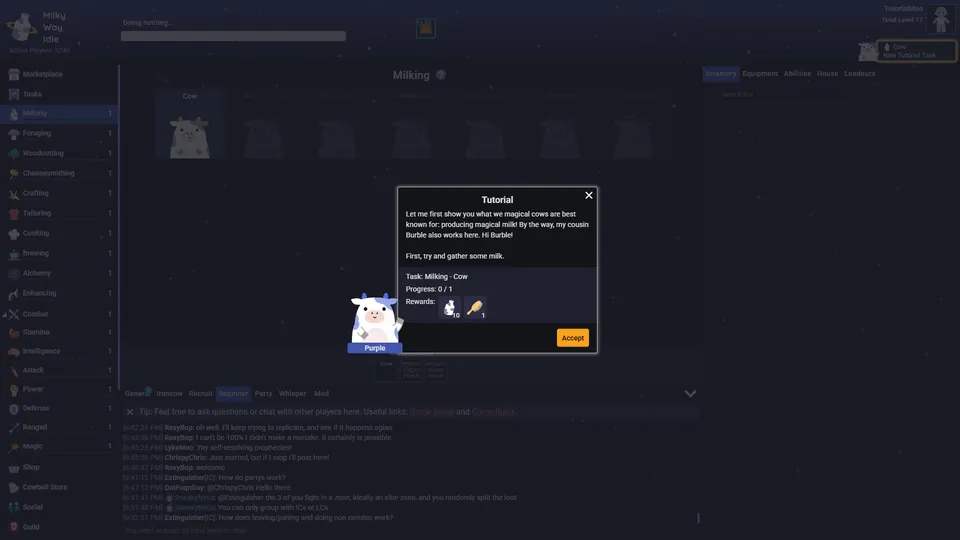
Finish the tutorial. It is a short set of tasks, and the Task board only opens after it. Tasks are one of the better early sources of coins, so do not skip it to go straight to grinding.
Then queue a gathering skill on repeat. Milking, Foraging and Woodcutting need no materials, so they can run forever. That makes them the right action to leave running overnight and the right last action in any queue: if the production job in front of it runs out of materials while you are away, the character falls through to gathering instead of standing still. Get into this habit on day one. An idle game punishes idle time more than bad choices.
Gather what your next skill eats. Gathering on its own is slow money. It gets much better once you process the output, so pick the production skill you want first and gather toward it.
How the skills feed each other
 Gathering
Milking, Foraging and Woodcutting. Raw materials, no inputs, repeat without limit. Collectors Boots in the feet slot give +10% efficiency to all three.
 Processing
Cheesesmithing, Crafting and Tailoring turn raw materials into tiers of cheese, lumber and fabric, then into equipment. They consume materials, so they stop when the stack runs out. The Eye Watch in the off hand gives +10% efficiency to these three.
 Culinary
Cooking makes food that restores health and mana in combat. Brewing makes teas for skilling and coffees for combat. The Culinary Hat gives +10% efficiency to both.
The two remaining non-combat skills, Alchemy and Enhancing, are different: both can fail. More on them below, because they are where new players lose the most.
Combat is a skill too, made up of seven subskills that together set your combat level. Your weapon decides the style: spears stab, swords slash, maces and bulwarks smash, bows and crossbows are ranged, and staves cast fire, water or nature magic. You fight single monsters, zones (groups with a boss) and dungeons (waves plus a final boss). Zones take parties of up to three, dungeons up to five, and party members split the experience and loot.
A practical order for a new market character: get one gathering skill and its matching processing skill going, use the output to make your own tools and gear, and only then start combat with that gear on. Fighting in starter clothes is slow, and the gear you make is the thing that fixes it.
Do your tasks
The Task board hands out a new task periodically, starting at one every 8 hours, with room for 8 waiting tasks. Tasks do not expire, so you lose nothing by letting them pile up for a day. They pay coins and Task Tokens, every token also counts as a Task Point, and every 50 Task Points gives a Purple's Gift with more coins, tokens and loot boxes inside.
Spend your first Task Tokens on the task cooldown upgrade. Each purchase cuts an hour off the timer, up to four times (8 hours down to 4), which doubles how many tasks you get. The wiki gives the same advice, and it is right: every other token purchase is worth more once tasks arrive twice as often.
Rerolling a task you do not want costs 10,000 coins or 1 Cowbell and doubles each time on the same task, up to 320,000 coins or 32 Cowbells. Early on, a reroll usually costs more than the task pays. Discard tasks you will never do and keep the slot free.
Three stats to understand early
Action time = base time ÷ (1 + total speed). All speed bonuses add together. 25% speed turns an 8-second action into 6.4 seconds.
A chance to repeat the action instantly for full XP and full output. Every 100% is one guaranteed repeat; the remainder is the chance of one more. 150% means 2 actions half the time and 3 the other half. It has no cap, and it does nothing for Enhancing.
A straight XP multiplier. All wisdom sources add together; on skilling actions they also add with charm experience before multiplying base XP.
Efficiency is the one beginners undervalue. Speed makes each action shorter; efficiency adds extra completions on top, each with full XP and output, at no time cost. When you choose between a speed piece and an efficiency piece, do not assume speed wins. Plug both sets of numbers into the time to level calculator and compare.
Enhancing and alchemy: read before you click
Enhancing makes equipment stronger, one level at a time up to +20. A failed attempt sends the item back to +0 unless you add protection, in which case a failure only costs one level. Success rates fall as you climb: 50% for the attempt to +1, 35% from +7 to +10 and 30% from +11 up, before your bonuses. If your Enhancing level is below the item's level, your rate shrinks further. At Enhancing 10 on a level 50 item you only keep 60% of the base rate.
That is why a beginner should not enhance anything they cannot afford to lose. Low levels on cheap gear are fine and give decent Enhancing XP. Do not push a good item past +5 without protection: the enhancing calculator shows that the average for +10 without protection is several times the average with it, because each failure past the midpoint throws away every earlier success.
Alchemy turns items into coins (coinify), into components (decompose), or into related items (transmute). A failure destroys the input and gives 10% of the XP. Treat it like enhancing: practise on cheap items and leave valuables alone until you know your success rates.

Using the market without losing coins
Normal items are taxed 2% when they sell; Cowbell Bags are taxed 18%. The tax comes out of what the seller receives, so a listed gap between the buy and sell price is not your profit. The trading guide walks one trade through the numbers, and the trading calculator does the arithmetic for your own prices.
Two habits keep new players out of trouble. First, place buy orders for materials instead of paying the lowest ask every time; idle players can afford to wait. Second, check what your own output sells for before you process it. Sometimes the raw material is worth more on the market than the thing you would make from it, and the only reason to process is the XP.
How long levels take
The XP curve is gentle early and brutal later. Level 10 needs 791 total XP, level 50 needs 93,311, and level 100 needs exactly 10,000,000. Level 125 is 100,000,000 and the cap at 200 is 100,000,000,000. Your first few dozen levels in every skill come fast, so do not over-plan them. Past 70 or so, the choice of action and your speed, efficiency and wisdom start to matter more than how many hours you play.
Beginner mistakes, in one list
- Leaving the queue empty. End every queue with a repeating gathering action.
- Ignoring tasks, or spending the first tokens on anything but the cooldown upgrade.
- Enhancing a good item past +5 without protection.
- Running alchemy on items you cannot replace.
- Reading a listed spread on the market as profit before the 2% tax and the risk of the order never filling.
- Starting combat in starter gear instead of making a set first.
Frequently asked questions
What should I do first in Milky Way Idle?
Finish the tutorial, which unlocks tasks, then queue a gathering skill (Milking, Foraging or Woodcutting) on repeat. Gathering needs no materials, so it never stops on its own.
Should I play an Iron Cow as a new player?
Only if you want to make every item yourself. Iron Cows cannot use the marketplace except to buy Cowbell Bags, and an account can hold up to three of them alongside a normal character.
How much XP is level 100 in Milky Way Idle?
10,000,000 total XP in that skill, per the wiki's experience table. Level 125 is 100,000,000 and level 200 is 100,000,000,000.
Game rules on this page come from the community Milky Way Idle wiki, checked 2026-10-15: Skills, Tasks, Efficiency, Action Speed, Wisdom, Experience, Enhancing, Alchemy, Combat, Iron Cow, Marketplace. Market tax rates match the rule this site's calculators use. The game changes with patches; if something here disagrees with what you see in game, the game wins.
Next: read the money making guide, plan a grind with the time to level calculator, or check an enhancement before you risk it with the enhancing calculator.