

When a listed spread is not a trade
The market board shows an ask, a bid, and a tempting gap between them. This guide walks one example through tax and fill risk so you can tell a real flip from a number that only exists if both sides fill. The calculators do the arithmetic; this page is the decision rule.
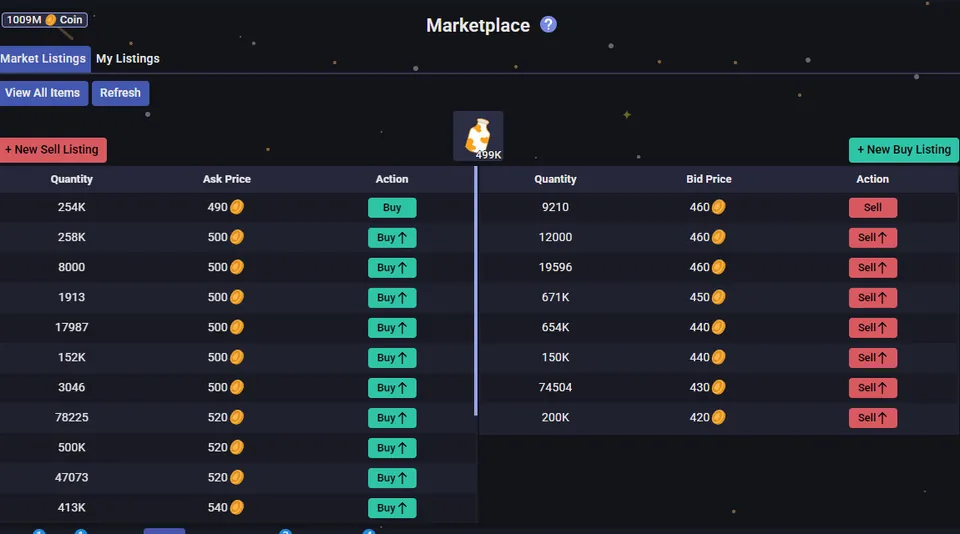
A worked trade
Take a listing with an ask of 1,000, a bid of 850, and the normal 2% marketplace tax (Cowbell-bag style items use 18% — set that on the calculator, do not assume 2%).
| Figure | Math | Result |
|---|---|---|
| Listed spread | 1,000 − 850 | 150 |
| Net sale if the ask fills | 1,000 × (1 − 0.02) | 980 |
| Potential spread after tax | 980 − 850 | 130 |
| If you pay the ask and dump to the bid | (850 × 0.98) − 1,000 | −167 |
The 150-wide listed spread is not what you keep. After tax the paper flip is 130, and only if you actually buy at 850 and actually sell at 1,000. Pay the ask instead and the same numbers lose 167. That is the whole difference between a listed spread and an executable trade.
Four checks before you click buy
The visible ask is the buyer’s sticker, not the seller’s pocket. Most sales lose 2%. A few named items lose 18%. Run the ask through the trading calculator before you treat the gap as profit.
A bid is what someone is willing to pay right now. An ask is what someone wants. Your flip needs both orders to fill at those prices. If either side is a stale or thin listing, the potential spread is a screenshot, not a plan.
If the bid barely beats the vendor value, listing to players buys you a wait. Vendor is the instant, guaranteed floor. Negative “bid over vendor” means vendor the item and stop looking for a flip.
On expensive items the ask is often a wish. Place your own bids — a ladder if you have a budget to spread — and let a dipping price fill the cheap rungs. Paying the ask on a wide gap is how a “130 profit” becomes the −167 row.
When to walk away
A 2–3% gap after tax is usually noise: one fill at a slightly worse price wipes it. If the calculator’s profit would not cover a missed fill, it is not a trade.
No ask, no bid, or a −1 / missing price on the item page means the cache has no pair to compute. Do not invent a spread from vendor value alone.
That is what the rare gear price check is for. A 400 million ask against a 220 million bid is a warning, not a bargain, until you have a fill plan at the bid.
What the calculators do not know
They do not know order-book depth, whether a listing is a minute old or a week old, or whether anyone will take your order. They apply the published tax rule to the numbers you type (or that the cache last stored) and stop there. Cached prices lag the game; the item page shows the fetch date when we have one. Buffs, teas, and production-session value are not calculated here — those pages were retired rather than ship a trading form under a false title.
Use the market board to find a candidate, the item page to read the current pair, and the trading calculator to tax it. If the taxed number still looks good after you name both fills, it is a candidate. If you need the other side to be lucky, it is not.